We are experiencing something all the time, but we do not feel it all the time. When you reach out your hand to someone, when you look at someone, you make contact with them. When you feel tired after a poor night, you are sometimes able to answer the question of what made the night so hard. Sometimes you may feel a need for closeness and suffer from being alone. At other times you may work twelve hours a day for many years without feeling what it does to you, until you burn out professionally or end up in hospital.
Zinker's cycle of experience
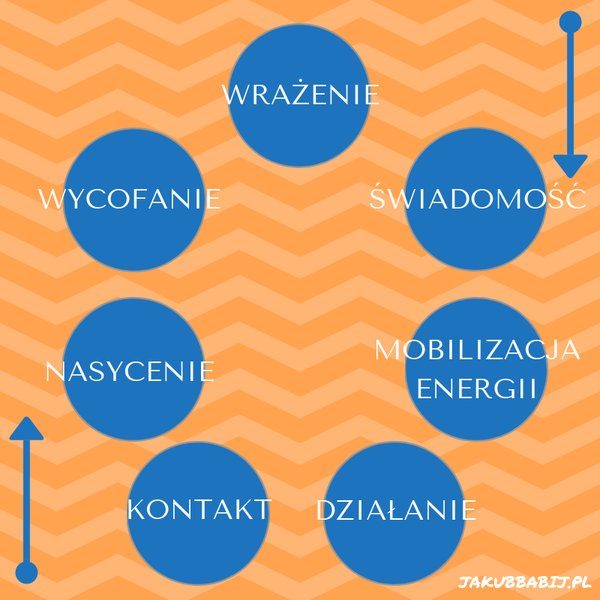
The way we experience our needs, phenomena and other people is described very well by Joseph Zinker's cycle of experience, also called the cycle of self-regulation or the contact cycle (you may also find it called the Gestalt cycle of experience, or the energy cycle).
The cycle consists of the following stages: Sensation of a need, Awareness, Mobilisation, Action, Contact, Satisfaction, Withdrawal.
An example: Peter and a glass of water
To see how this cycle works, let us use an example. It will be a simple one. Simple examples are easier to remember. :)
SENSATION. Peter is working at his desk. At some point he begins to feel that something is not right.
AWARENESS. Peter realises that he has had nothing to drink. The last drink was a coffee five hours ago. Peter also realises that he has not got up from his desk for three hours, and that his back and neck hurt.
MOBILISATION. Peter decides that it would be good to have a drink and perhaps move around a little.
ACTION. Peter gets up from his desk and goes to the kitchen for some water.
CONTACT. Peter is in the kitchen. He drinks water. He feels that he is still thirsty. He pours a second glass. He straightens his back and stretches his arms up, trying to ease the tension in his back.
SATISFACTION. Peter feels satisfied. The thirst is gone. He still feels tension in his back, but at least he no longer feels like drinking.
WITHDRAWAL. Peter goes back to his desk and his work. The thirst is gone and no longer gets in the way of his work.
Peter had a drink. He managed to avoid dehydration. That is a big plus. It went somewhat worse with his back. Trying to stretch and raising his arms was not enough, and will not be enough, for Peter to avoid the chronic back pain that will appear in a few years. He will then hear from his physiotherapist that for years he did not look after his back and sat badly for most of his life.
The cycle of experience shows how we are aware of our needs and how we fulfil them. With physiological needs it is theoretically easiest: we want a drink, so we drink. We want to go to the toilet, so we do. Relief appears, and a kind of closure. The cycle closes so that the next one can open. In this context, health, as Joseph Zinker understood it, is the ability to be aware of our needs and to meet them skilfully. The cycle works in the same way with more complex needs, for example the need for closeness, the ability to express one's own opinion, to say "no", to ask for help. We can fit practically any experience into the cycle above.
Interruptions in the cycle of experience
Unfortunately there is a problem. Meeting needs is not always as textbook as in the case above. It happens that each of us "snags" at one of these stages, or even at several. We can get stuck at the stage of sensation: our body tells us nothing, our senses give us no information. We can get stuck at the stage of awareness. An impulse towards some movement, towards some need, has appeared. What is more, we even know what our next step might be, but we cannot move on to mobilisation. We know what to do, sometimes we even know how, but it does not translate into movement. If we get stuck at the stage of mobilisation, we are like a runner who is preparing for a marathon, has read everything there is, bought a ton of equipment, but never signed up for any marathon.
One can get stuck between contact and withdrawal. We close new projects, start new jobs, end new relationships, start the next ones. Without a moment's pause, without reflection. No joy at success appears, no sadness at loss. Always on the run.
We are then a little like a mountaineer who has just climbed his first major peak in the high mountains and, instead of taking comfort in the moment and simply sitting down to look at the summits, takes out his smartphone and checks what his next climbing goal will be.
If at some point the cycle does not close, we are in a way left suspended at one point, and the unclosed cycle slowly begins to affect other cycles and other experiences we live through. Tension may appear, anger, a lack of satisfaction…
In Buddhist descriptions of the hells there is the hell of "hungry ghosts". They have big bellies, narrow throats and small mouths. Eternally unsatisfied, eternally hungry. Sometimes they do not know what food would feed them, or do not know how to get it, or keep searching for it even though it is right in front of them. If we hang suspended at one of the stages of the cycle, we metaphorically become exactly such a "hungry ghost".
Interruptions in this cycle may be connected with how our needs were met in our family home. For example, if in your home there was no space for expressing your needs, and your voice and opinion were not heard, growing up you may have concluded that expressing your needs is entirely impossible. Let us bring this down to an example: it may irritate you that your partner smokes in the bathroom, and you do not like it. It annoys you and distances you from him. You feel tension, but you do not tell him directly, afraid of his reaction. In the end your anger finds an outlet in a small quarrel with your youngest child.
Interruptions in the cycle are completely natural and appear in everyone. In Gestalt psychotherapy we do not treat them as a disorder, but rather as a kind of adjustment, which had to develop as a reaction to the environment, the family or the conditions in which we happened to grow up.
Gestalt psychotherapy
Psychotherapy deals, among other things, with increasing awareness of at which stage of the cycle we get stuck, what causes this, and what is possible in order to get out of the impasse. The greater our awareness of the interruptions in our cycle, the greater our freedom. We are no longer like a snake in a bamboo tube that can only crawl forward. We can choose the direction, we can choose the speed. The more freedom there is in our actions, the more relaxation, the less tension. With wishes for the greatest freedom in your everyday choices…
More posts on interruptions in the cycle of experience are coming soon, longer and more thorough. In the meantime, if you like and you know English, take a look at the video below showing what the cycle of experience is.